Monday, 9 September 2019

A Farewell thanks to Brexit

It is surely not a secret anymore: BREXIT did hit the British economy!

An era ends for now - tribute to my life project


In the current political climate it’s an understatement to say a lot can happen in 24 hours. In my case It’s been an interesting few weeks and months, some which saw my business struggling of the uncertainty our clients face.

8 years ago I decided to relocate from Germany to the UK and to rebuild my business (Rock Ya Events Group Ltd.) in Scotland. The country I am very proud to call now my home! The home where you settle and where you want to stay for the rest of your life. Fairly quick I learned about the culture, the history and also everything what I needed to know about the tourism industry to start my first job as tour guide. I started to follow my personal dream - to explore and experience Scotland, my new home.

Everything went pretty much to plan and I have been able to form a business in the event and tourism industry. After a couple of years of guiding I have been able to generate a decent turnover as sole trader delivering travel expeiences next to my event business. A start of a great journey since this changed my business model and we developed to an Event & Destination Management Company with loads of great clients and projects. A journey which did reach the next level another couple of years later ... Private Limited status. This was certainly a new chapter not only in business life also as private person. Different approaches, more responsibilities and also creating job opportunities. Another mile stone reached. 

Anyway, this journey now seems to take a complete different direction. Lots of things changed not that long ago and reason for this is very much in every one's mind these days. As company working predominantly for the European market the political situation around the UK became more and more of a uncertain terrain and with this some sort of a hassle. I understand that this topic devides opinions and could also cause a bit of unease. But for quite a while now I have quitely listened to people talking about this situation. I tried to stay away from rumour as long as possible for the sake of not getting dragged into this too much myself. I experienced the change from "Will be fine" to "Not sure how this will end", about issues and fear regarding the uncertainty of what to do. Even after all this I still tried to stay away from all the scaremongering and overreaction, all the avoidable actions to be made mainly for preperation and protection.

The UK is renowned for its events industry. Worth an impressive £42.3bn to the UK economy in 2018, the sector is made up of over 25,000 companies – spanning from venues to marketing organisations and suppliers. With the UK consistently ranking third place in the 2015, 2016 and 2017 ICCA rankings as a destination for business events, it's responsible for a huge influx of international entrepreneurs every year. Hence it accounts for £19.9bn annually, overseeing 1.3 million conferences and networking sessions. The looming uncertainty surrounding Brexit, however, has made it difficult to pinpoint exactly how the UK’s departure from the EU will affect businesses involved in running and managing events. For instance, international trade and investment are fundamental to the events industry which relies on strong business connections and trade links.

Within 12yo providing unique and bespoke events to hundreds of clients in Europe we experienced a lot of great development and changes. Innovation and also creativity. But now it’s time to invest in myself, focus on my path and find a new assignment. Change is a constant we all live with and being the person we are, in our book, it’s not something to run away from. Instead it presents an opportunity for reflection, renewal and growth. The change also comes with new perspectives, new perceptions and purposes.

Without bringing politics to much into this.... since I had to apply for the Indefinite Leave in the United Kingdom under Appendix EU to the Immigration Rules (so called "settled status") with the British Goverment I have voiced my opinion to everyone who asked me and I can openly admit that I am a proud European citizen. One who doesn't agree with the current leadership of the United Kingdom and what also happened in 2014. However, as buisness owner I don't wanted to upset anyone or even cause any harm.  Interesting video for this here .

Although my email inbox is still filling up with tips and news about Brexit prevention, every day I hear, read and see the anxiety becoming more and more present. Companies start to change their concepts or close down, suppliers start struggling to deliver, clients cancel jobs, employers start to panic, staff are getting made redundant. But even more scary.... contracts with loyal staff are not getting extended and so these professionals have to start looking for job opportunities. This made me think and I started researching and wondering. Will Brexit affect me? Will I suffer from it? What could I have done better? Until I found out that there is nothing really what could have done different. But it is how it is ... the UK will most likely leave the European Union and with this will also loose a lot of economical connections. Scotland and some of it's businesses reached the point not knowing how to survive this ucertainty. How to overcome the struggle of loosing business and the financial long haul.

As founder and director of a SME in the event industry working closely with the European market I now sadly reached the point where I have to realise that I can't ensure a consistent service to our clients any longer due to the political uncertainty. After long and intense considerations, I decided to put our event department (Rock Ya Events) on hold until the economical and political situation settled down and developed more clarification. Although we will still operate with our existing DMC department (Rock Ya Scotland), we hope very much to come back soon in full scale continuing to create memorable and unique event experiences for clients who appreciate the dedicated work containing in our bespoke and unique services.

Whilst uncertain I’ll embrace the opportunity to reach out to all our clients we’ve had the privilege of providing and all the partners whose support has proved invaluable to say  

"Thank you!"

I sincerely hope we’ll find a means to continue working for and with you. I'll now look for alternative options, to which I can bring my extensive work experience and skills achieved within many various environments in the event and tourism industry to the table.

#positive #attitude #entrepreneurship #eventprofsUK #eventprofs #bettertimesahead #worklifebalance #development


Pierre Kruff
Managing Director
Rock Ya Events Group Ltd.

Monday, 19 August 2019

UKs ugliest word of the year

Back in the days, where the ‘ugliest word of the year’ haven’t affected society, we kind of made fun out of the choosen word. We used this unloved word whenever and whereever we could, just for fun.

Today, I am getting quickly annoyed of that word  everyone seems to talk about. The word what caused already a lot of problems, suffer and anger in the same time. The word everyone is not even about how much more damage it will cause. The word which started speculations, indications, closures and arguments. The word what let’s us from other countries look like unwanted immigrants. The word which would never caused such problems if we all would have listened carefully to John Lennon’s famous lyrics of “Imagine”...

Imagine there's no countries
It isn't hard to do
Nothing to kill or die for
And no religion too
Imagine all the people living life in peace.

Imagine no possessions
I wonder if you can
No need for greed or hunger
A brotherhood of man
Imagine all the people sharing all the world.

Do you also start thinking now about the “ifs” the “woulds” and the “coulds”? Then you feel my pain and you also might understand why I started to feel very irritated about the whole thing.... BREXIT

Often I get asked how this could affect me at all since I live now since such a long time in the United Kingdom. It’s quite easy to explain:

1) The contents of my shopping basket changed...

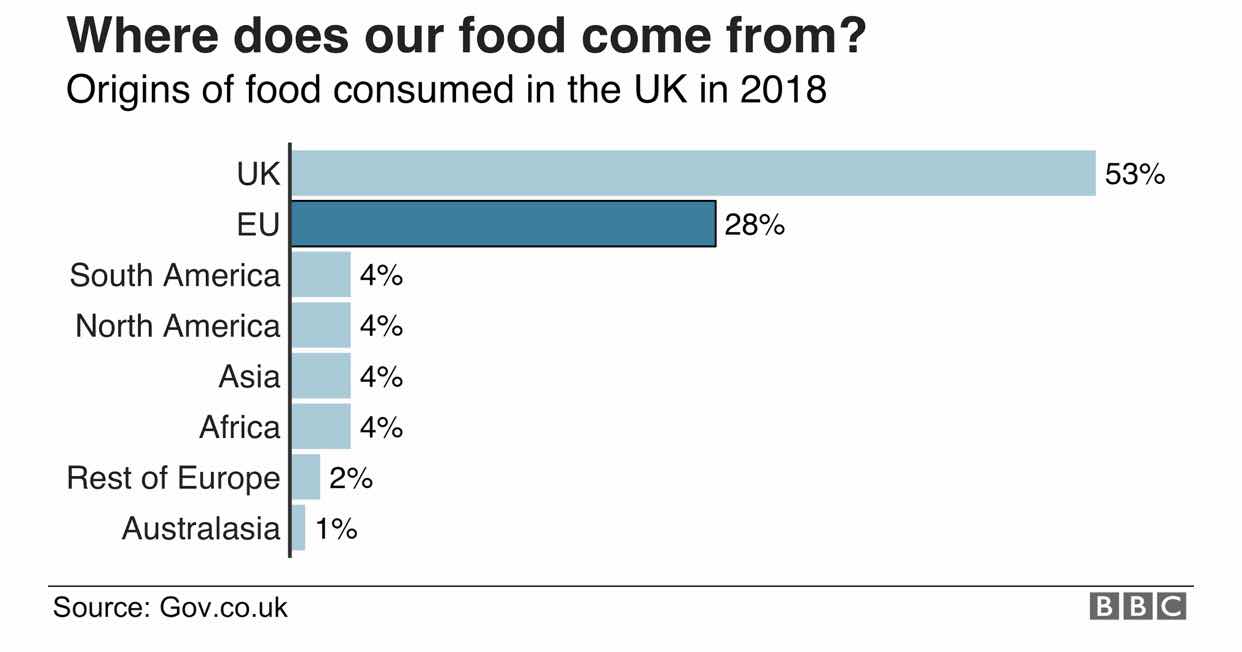
Almost 30% of our food currently comes from the EU, and it is likely that some foods, such as fresh vegetables and fruit, will become more scarce and more expensive in the event of no deal.


Increased import taxes and transport delays could all mean a rise in prices. And if a no-deal Brexit was followed by a fall in the value of the pound, that would also have the same effect.

Supermarkets themselves have warned that there could be empty shelves and higher prices. And Bank of England governor Mark Carney has said that, in a worst-case scenario, our shopping bills could increase by 10%.


The government has said that while a no-deal Brexit alone won't lead to food shortages, consumer behaviour could. Panic buying could mean food retailers run short of some products. 

In preparation, supermarkets say, they have been stockpiling some foods - but they are unable to do that for some fresh fruit and veg. Sainsbury's has also said October would be one of the worst times for the UK to exit the EU without a deal because warehouse capacity is already strained by he seasonal stock build-up ahead of Black Friday and Christmas, limiting supermarkets' ability to store goods ahead of Brexit.

Shoppers planning to buy from companies based in the EU, Norway, Liechtenstein and Iceland after a no-deal Brexit have also been warned credit and debit card charges may be higher and payments may take longer. 


2) We will need to take extra measures when travelling to Europe

Millions of people from the UK travel abroad each year - the vast majority of journeys made to Europe.


With this issues with passports, visas, border control, health cover, travel itself and bank cards will arise.


3) Medication might be not available or it may be more expensive

Ministers and NHS leaders say every effort is being made to ensure there will be enough medicines and clinical equipment available in the event of delays to imports from the EU. While there are regular fluctuations in medicine supplies, there are concerns a no-deal Brexit could make shortages worse. 


About three-quarters of the medicines and most of the clinical products we use come from or via the EU. 

4) EU citizens need to apply for 'settled status'

Just today I had to experience a complete different level of frustration. Visiting the local migrants help group to get informed about options, opportunities and help for applications. The UK government has reached an agreement with the EU, as well as Norway, Iceland, Liechtenstein, and Switzerland, that will protect the rights of EU citizens and their family members living in the UK.

There are about 3.7 million EU citizens living in the UK.


5) Importing goods from the EU may get more expensive

Importing goods from the EU is likely to get more expensive when free movement of goods ends with the UK's departure.

As a member of the EU, UK firms don't have to pay extra duties, taxes or have customs checks on goods travelling to or from the EU.

But after a no-deal Brexit, new rules will apply. UK businesses will need to apply the same processes to EU trade that apply when trading with the rest of the world.


Working in the event and tourism (inbound) industry (link) I am predominantly working with the European market. We organise corporate events, incentives and travel experiences in/to Scotland. With all uncertainties arising our clients have decided not to invest in an event or in travelling in UK. But with us specialised in tailor-made whisky tours we also face the problem coming up with the whisky market. What will it mean for us and how will we be able to generate business in future?

Running your own business as entrepreneur during such a difficult time obviously affects your entire life circumstances. Therefore also social contacts such as family, friends and colleagues and everywhere you can feel a tightness. Trying to find answers and security is tiring and you come to the conclusion that whatever will happen it will happen anyway. But thanks to Brexit supporters such as David Cameron, Theresa May and Boris Johnson the United Kingdom’s economy will crash...sooner or later. But the perspective on Brexit is changing... read here

Farewell Europe. Farewell “united” Kingdom

Thursday, 27 September 2018

5 Simple Comebacks For Dealing With Rude People

Rude people really are annoying, but there's no way to get around it: you're going to run into one now and then. Here are 5 great ways to deal with rude people.

1. Tell them you appreciate their perspective.


When someone is being rude to you, they don't expect graciousness, or any kind of positive emotions to come at them. If anything, it'll disarm them and make them realize you appreciate different viewpoints, including theirs.

2. Thank them.


Put on a smile and say "thank you." It's a subtle way to acknowledge their rudeness and opt out of engaging them on it. It shows you're in control of your emotions.

3. Tell them they're right.


Just because someone is rude doesn't make what they have to say incorrect. If someone rudely points something out, tell them they're right. It almost always gives them pause. They expect you to argue, not concede.

4. End the conversation.


There's nothing wrong with saying a conversation with a rude person is over. You're in charge of who you talk to about what. If you're being disrespected, walk away.

5. Laugh.


Because what's funnier than laughing in the face of a rude person?

Stay focused and watch out for more blog post!

Monday, 24 September 2018

6 Insightful Questions to Ask Yourself

Hasn’t Your Hard Work Paid Off (Yet)?

Think back to when you were in school. Do you remember that one person who stood out? That person whom everyone thought would change the world someday? Parents and teachers showered the person with praise for their grades. Wherever you went, you overheard people talk about the things that person would go on to do one day.

Now fast forward a decade or two to the present day. Nobody has seen the person achieve anything spectacular or noteworthy. In fact, nobody has heard anything at all. Maybe you know someone like this. Or maybe, you are that person.

I used to think that the recipe to success was a combination of hard work and intelligence. But it turns out that’s not the case. While they’re important qualities, other factors come into play as well.

Developing Focus and Creating Opportunities for Yourself

Most people go about their lives trying to get through each day. Rather than working towards a long-term goal, they work aimlessly, counting down the hours until they can take a break or catch up on the next episode of their favorite show.

We all have aspirations that we want to achieve someday, but the problem is that they’re often just far-reaching dreams that bear no resemblance to reality. We might even have numerous goals, but we just can’t get around to doing it all.

And as Sylvia Plath once said — “Perhaps when we find ourselves wanting everything, it is because we are dangerously close to wanting nothing.”

Do you find yourself being pulled in numerous directions? Do you change your mind often about where you want to spend your time and energy?

If you said “yes” to both of these, then you need to figure out what exactly do you want. When you become clear on where you want to go, you can devote all your resources towards heading in that direction. With your destination in mind, you can increase your chances of success by doing the following:
  • Connect with others.
  • Open yourself up to chance.
  • Make the most of your opportunities.
  • Commit yourself to your goals.
  • Believe in yourself.
When you work on each of these factors, you can combine your intelligence and work ethic into creating something of value.

*

With that in mind, ask yourself these 6 insightful questions on why your hard work hasn’t paid off (yet):

1. Do you reach out to new people?


Let’s face it — it’s easier to hang around old friends than reach out to strangers. When you meet up with the same people, you know what to expect and feel at ease immediately. But it’s just as important to introduce new people into your life as reuniting with old friends. Why? Because you get stuck in a bubble when you always meet the same people over and over again. The group dynamics are static, and people tend to recycle the same ideas. Whenever I meet a new person, I get to hear their story and learn new things. I learn about their experiences, their aspirations, and their perspective on life.

It can be tough to reach out at first, but starting small can help. Aim for a small goal, such as meeting one new person a week. You can reach out by introducing yourself to someone where you frequent or by emailing someone to share ideas or ask for advice. Maybe you’ll only talk once, or maybe you’ll keep in touch and collaborate on a project.

2. Are you taking risks?


There are two types of risks:

- Blind risks, which involve greater downside than upside.

- Calculated risks, where the upside is greater than the downside and it’s potentially life-changing.
 
When you take risks, you have to think about the potential loss and potential gain from it. Unfortunately, a lot of smart people opt out of both and choose the safe route. They follow the same path as their peers or choose a career that’s socially acceptable.

Jeff Bezos, founder and CEO of Amazon, shared how he decided to quit his secure job at an investment company to create an online bookstore. Here’s how he used what he calls the “regret minimization framework”, in his words:
“So I wanted to project myself forward to age 80 and say, ‘Okay, now I’m looking back on my life. I want to have minimized the number of regrets I have.’ I knew that when I was 80 I was not going to regret having tried this. I was not going to regret trying to participate in this thing called the Internet that I thought was going to be a really big deal. I knew that if I failed I wouldn’t regret that, but I knew the one thing I might regret is not ever having tried. I knew that that would haunt me every day, and so, when I thought about it that way it was an incredibly easy decision.”
Eventually, you need to consider what’s best for yourself in the long run. Would you be happier knowing that you took a calculated risk that didn’t pay off, or if you took the safe path?

3. Do you mistakenly assume that credentials lead to success?


“I went to [insert school], so I deserve [X].”

This is a line that I commonly hear from highly intelligent people who have worked hard all their lives and expect to be compensated for it. Sadly, that’s not how things work. High-achieving people tend to have an impressive alma mater, many achievements, and high grades. They’re used to being at the top and receiving praise for whatever they do.

While these things feel nice at the time, they can also lead people who have succeeded in school to believe they can coast on their previous achievements.

As Mark Twain said — “I have never let my schooling interfere with my education.”

So don’t stop learning. Read. Experiment. Talk to people. Use real-life experiences to supplement the knowledge that you already have.

4. Do you go out of your comfort zone?


Being stuck in the same environment for a long time makes it hard to adapt to new situations. You grow complacent and eventually become fearful of anything new, even if the changes are for the better. Embrace discomfort. It’s the only way to grow and get better.

For example, when I needed to contact people for feedback on my work, I was hesitant. But once I reached out to a few people and received a response, I decided to try it again. Now, it’s become a regular habit that doesn’t daunt me anymore.

If you find yourself making excuses and resisting something new, pause for a moment. Ask yourself: Will doing this make me a better person in the long run? Sometimes we don’t say “no” because something is unimportant. We say “no” because it’s the very thing we need to become better.

5. Do you stick to your decisions?


Smart, hardworking people are frequently told that they’re smart, they’re capable, and most of all, that they can do anything they want. This is where the problem lies.

You see, being smart and hardworking means that people tell you that you can achieve anything if you just put your mind to it. You’re told that there are all sorts of possibilities. The world is your oyster.

But having all sorts of opportunities can be just as crippling as not having enough of them. Being overabundant in choices makes it difficult to know what to do. As a result, it’s easy to dabble in different things and “see what suits you”. Before you know it, a decade has passed and you haven’t achieved much.

So if you’re thinking of pursuing a route, talk to different people and learn more about it. That way, you’ll get a better feeling for what suits you instead of diving straight in. Focusing your efforts on one goal yields much better results than dividing your attention among many goals.

6. Do you believe in your capabilities?


Smart people can be self-critical...and I am very bad for that myself. We look at the work we create and always find something wrong with it. While I believe this attitude can help people push themselves to do more, it can also keep them from getting started in the first place. Perfectionism causes to overthink, to doubt, and to do anything except take action.

When you use negative phrases to describe yourself, you eventually start believing that they’re true. If you have a tendency to do this, rephrase those sentences in your head. For instance, if you think “I’m not a good runner,” your actions will start to reflect this and you’ll give up. Instead, here’s a better phrase to use: “It’s not that I’m a bad runner. I simply need to train more often to become a better runner.”

See how the belief changes from something innate to something that’s within your control?
Everyone was a beginner at some point. But when you change the words you use to describe yourself and your work, it becomes easier to keep practicing and finding ways to get around setbacks.

Create Consistency to Succeed


Yes, intelligence and work ethic are important qualities for success in any field. But what we often overlook is consistency. Consistency means doing what’s required of you to reach your goal, regardless of what happens. It means putting in the effort even when the work feels mundane, when you’re tired, and when the results seem uncertain.

Believe in yourself, in what you do and in what you dream for!

Sunday, 24 June 2018

13 Symptoms of depression we never talk about

Living with depression can give us a whole range of symptoms. Some are quite well known, such as low mood, sleep difficulties, and limited energy. Other symptoms are less well-known, or less talked about. Our depression may bring symptoms that we find embarrassing. Because of the silence around them, we might feel as though we’re the only people in the world to experience them. However the truth is many of us share the same symptoms – we just don’t talk about them. Drawing on the lived experience of our community, we’ve identified 13 less-talked about symptoms of depression.


1. CRYING OVER NOTHING
We can cry over things that appear like nothing. It can be something as small as not being able to match up all the socks in our load of washing. We can feel permanently tearful. Absolutely anything can set us off.

2. FEELING ‘NOT THERE’

Sometimes we find ourselves losing time. We realise we have been staring into space for minutes or hours on end. Sometimes we feel detached from our environment. At times it can feel like there is a space, or an invisible wall between us and other people.

3. FORGETFULNESS

We forget where we left our keys, what time an appointment was, that we were supposed to pick the dog up from the vet. We have to write everything down. If it’s not written down, we will forget it (and sometimes we forget it even if it is written down).

4. GUILT

We feel guilty for letting our family and friends down, for using up professionals time, for just not being enough. Guilt gets us about pretty much everything and it can completely swallow us up.

5. IRRITABILITY

We spend so much time trying to cope, that if anything goes a little bit wrong, or alters our plans, it can make us snap. We feel irritable and little things that happen, that wouldn’t normally wind us up, can tip us over the edge.

6. INTRUSIVE THOUGHTS

We can be trying to go about our day when intrusive thoughts make an unwelcome appearance. Sometimes we can be cooking tea, and thoughts will appear with different ways we should hurt ourselves. We can walk down the street and intrusive thoughts will pop up, telling us to harm ourselves. They can seem to enter our brains with little or no warning and they can be completely overwhelming.

7. LIMBS MADE OF LEAD

It can feel as though our limbs are made of lead. We make a cup of tea, but lifting it to our lips feels impossible – our arms are too heavy. We want to walk to the shop over the road, but too heavy to move. Doing anything at all feels like wading against a strong current with rocks weighing us down.

8. LOSING OUR LIBIDO

Depression can cause us to lose our libido. Sometimes the medication we take for our depression can also cause loss of libido, or can make it worse.

9. PERSONAL HYGIENE

We often struggle with personal hygiene. We don’t care about ourselves enough to keep up with it. Because we’re low on energy, we don’t do it unless we prioritise it. We stop cleaning our teeth as often as we should, if at all. We stop washing our hair – we stop washing full stop. Hairbrushes go out of the window, as do visits to the hairdressers. Our PJs stay on for days on end. We don’t shave. We become embarrassed by the way we smell, the knots on our hair and the dirtiness of our hands. However uncomfortable and embarrassed we feel about it, we still struggle to motivate ourselves to fix it.

10. PROBLEMS WITH FOOD AND DRINK

Depression can destroy our appetite which can cause us to lose weight. It can also cause us to comfort eat, or to try and eat away the empty feelings which can cause us to gain a lot of weight. We sometimes rely on takeaways and ready meals because we don’t have the energy, motivation, or brain space to cook. That can lead to an unbalanced diet. Many of us struggle to drink enough which can result in headaches, tiredness, and feeling sick. We can also experience digestive problems such as acid reflux.

11. STRUGGLING TO LOOK AFTER THE HOUSE

General household tasks can feel like insurmountable obstacles. We end up leaving our sheets for months on end. Brushing the crumbs from the table to the floor instead of getting a cloth out. Resorting to crockery we haven’t seen in ten years instead of washing up (or giving up on crockery entirely and eating out of the packet). We don’t invite people over because we’re embarrassed by the mess we live in. Our houses stop feeling like homes but we don’t have the energy to fix it.

12. TOILETING TROUBLES

Depression can cause our bowels to do different things. It can lead to wind problems which can be incredibly uncomfortable. It can cause our bowels to work too well or not well enough. Sometimes it can affect how well we are able to wee. Depression doesn’t just affect our mind, it affects our bodies, too.

13. USING NEGATIVE COPING MECHANISMS

Sometimes we self-harm. Some of us use alcohol to cope with our feelings. Others will use cigarettes or non-prescription drugs. Some people might use different behaviours around food. Others may develop problems around shopping, or gambling, or sex. Resorting to these behaviours can feel shameful. It can make us feel hopeless, but we are not alone.